Every year thousands of visitors travel to Seville to experience one of the most impressive religious and cultural celebrations in Europe.
Introduction
Semana Santa in Seville (Holy Week) is one of the most spectacular traditions in Spain and one of the most important cultural events in the city. For an entire week, the streets of the historic centre of Seville are filled with processions organised by hermandades, religious brotherhoods with centuries of history.
Each procession represents scenes from the Passion of Christ and forms part of a tradition deeply rooted in the identity of Seville.
What will you see during a procession?
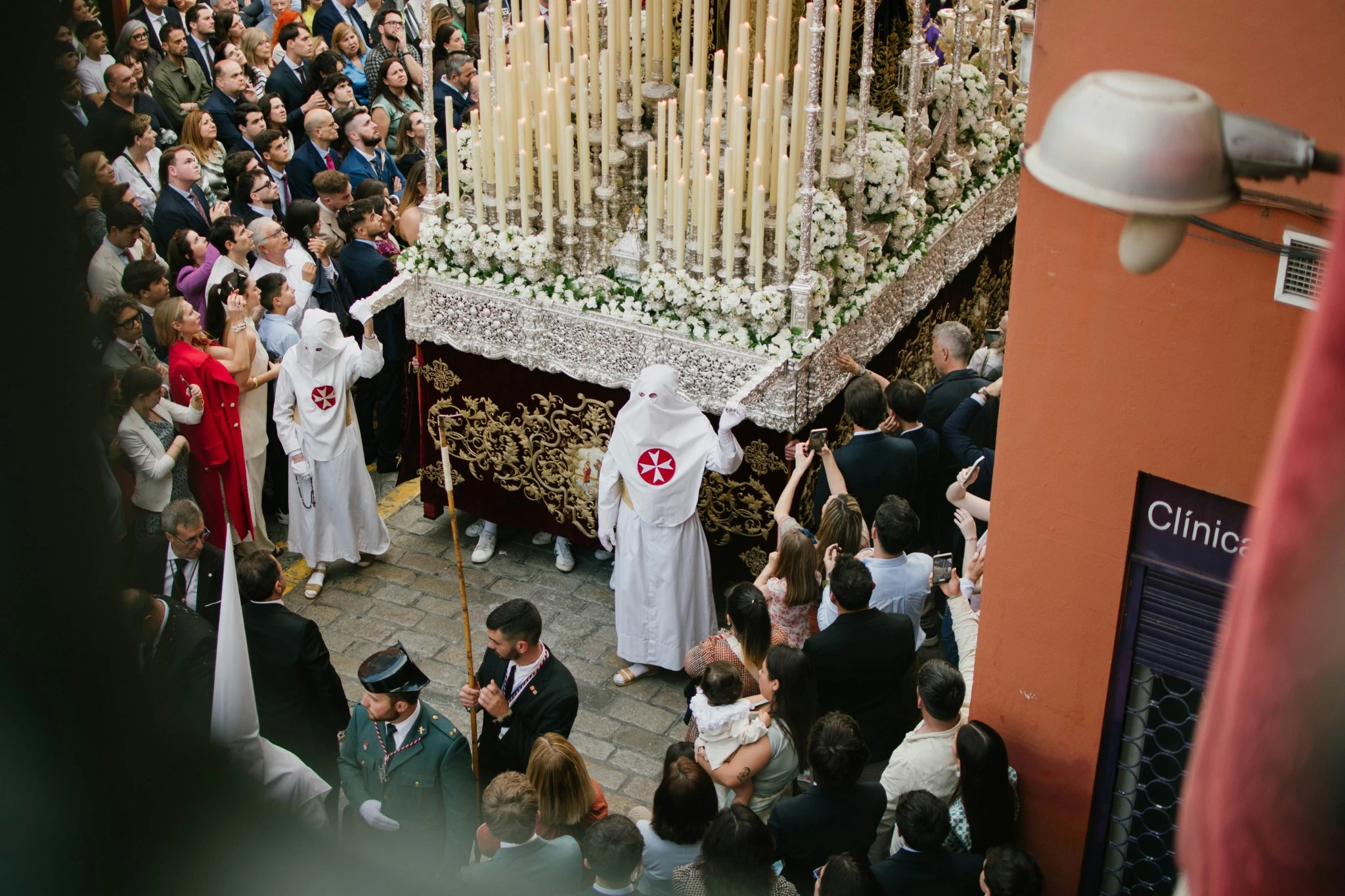
The floats(pasos)
The pasos are large decorated floats that carry religious sculptures of Christ or the Virgin Mary. Many of these sculptures are authentic works of art, and most of the most iconic images belong to the Sevillian Baroque school of the 17th century, created by artists such as Juan de Mesa, Martínez Montañés or Luisa Roldán, the first recorded female sculptor, known as La Roldana, daughter of the sculptor Pedro Roldán.
In many processions there are two floats: one dedicated to Christ and another to the Virgin Mary. In Seville, the float carrying the Virgin is known as a palio float, as the image is placed under a canopy supported by poles.
The costaleros
The costaleros are the people responsible for carrying the floats on their shoulders. They walk underneath the structure for hours following the instructions of the capataz, who directs the movement and rhythm of the float.
The nazarenos
The nazarenos are members of the brotherhood who accompany the procession wearing traditional robes and pointed hoods. Many of them carry candles or crosses as they walk through the streets of the city.
Music and saetas
Many processions are accompanied by marching bands that perform traditional processional music.
At certain moments you may also hear a saeta, a powerful flamenco-style song sung a cappella from a balcony or from the street as the float passes.
La Madrugá: the most famous night
One of the most intense moments of Semana Santa in Seville is La Madrugá, the night between Holy Thursday and Good Friday.
During these hours some of the most famous brotherhoods in the city process through the streets, including La Macarena, El Gran Poder and La Esperanza de Triana.
Thousands of people stay in the streets throughout the night to witness these processions.
Tips for experiencing Semana Santa in Seville
Arrive early, as some streets become very crowded.
Wear comfortable shoes, as you will walk quite a lot.
Explore different neighbourhoods, not only the historic centre.
Remember that for the people of Seville this is an important religious celebration, so it is important to maintain a respectful attitude.
Discovering Seville through its traditions
For visitors, Semana Santa offers a unique opportunity to discover the history, traditions and cultural atmosphere of Seville.
Understanding this celebration helps visitors better appreciate the identity of the city and the close relationship between its neighbourhoods and religious brotherhoods.
For many international visitors, this cultural experience also becomes the perfect opportunity to learn Spanish in Seville while discovering the city from a local perspective.
At Giralda In & Out, we offer intensive courses, cultural immersion and an international community in the historic centre of Seville.
Discover our programmes and experience Seville from the inside.
Intensive course
If you are looking for a complete experience in the heart of the city, discover our intensive Spanish course in Seville.
About us
Who are we? Learn more about our team and our philosophy here.
Cultural activities
We integrate this authentic Seville into our cultural activities for students.